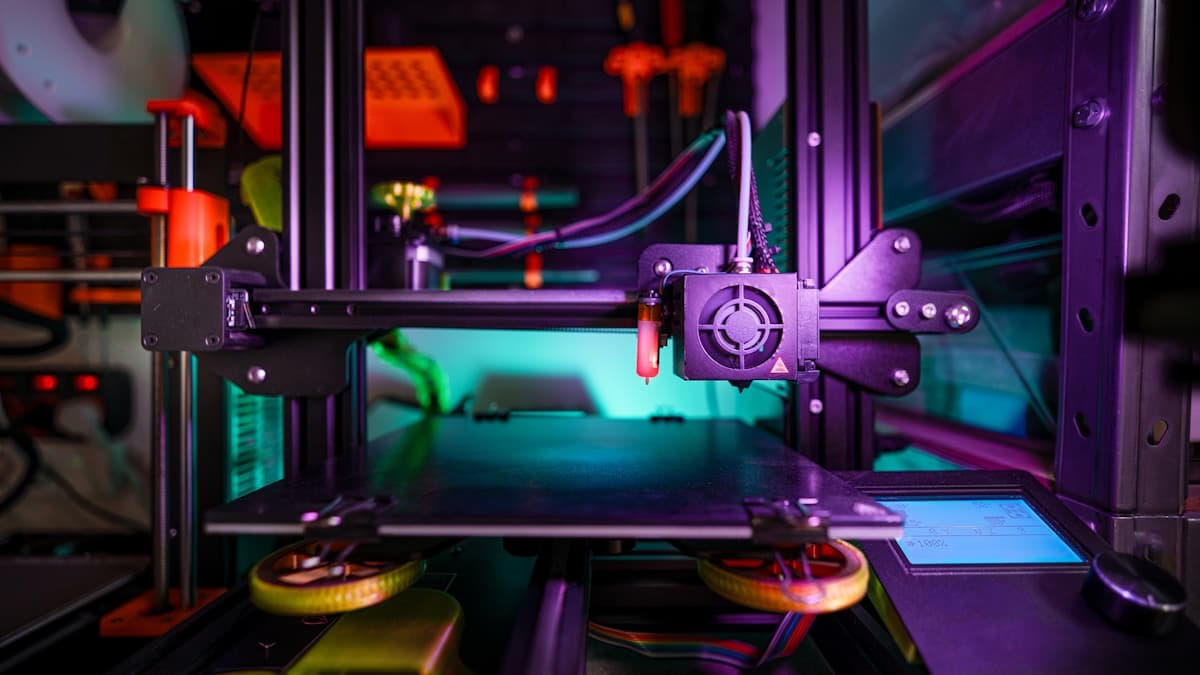
The direct answer: for professional project work, use a commercial 3D printing service bureau via the 3D Prototyping Hub directory. Search by your state and city to find verified local providers with available technologies, lead times, and direct quote request forms.
If you're trying to understand what types of 3D printing labs exist near you, which one fits your use case, and what to check before committing — this guide covers all of it.
The Three Types of 3D Printing Labs
"3D printing lab near me" returns results across three fundamentally different types of facilities. Understanding which category a lab falls into tells you most of what you need to know about whether it's right for your project.
Type 1: Commercial Service Bureaus
What they are: Businesses that print parts for clients on a contract basis. You submit a file, receive a quote, approve it, and get finished parts delivered. The shop handles everything — machine selection, material, settings, quality control, post-processing.
Who they're for: Professional project work. Engineering prototypes, design validation, production runs, functional testing. Any situation where output quality and reliability matter more than per-part cost.
Access model: Open to any buyer. No membership required. Quote-based pricing per project.
Technology range: Varies widely. FDM shops are common and widely available. Full-service bureaus with SLA, SLS, DMLS, and multi-material capability exist in most mid-to-large US metros.
How to find them: 3D Prototyping Hub directory — filtered by your state and city. Every listing includes available technologies and a direct quote request form.
What you pay: Per-part pricing based on material volume, machine time, post-processing, and setup. Typical range: $50–$500 for a standard prototype depending on technology, size, and material.
Type 2: University and College Labs
What they are: On-campus fabrication facilities operated for enrolled students, faculty, and affiliated researchers. May be department-specific (engineering lab, design lab) or centralized (library makerspace).
Who they're for: Students working on coursework and thesis projects. Faculty and researchers. In some cases, affiliated startup teams in university incubator programs.
Access model: Typically restricted to the campus community. Some university makerspaces with community outreach missions allow external members.
Technology range: Depends on the institution. Large research universities often have impressive hardware — industrial-grade FDM, multi-material SLA, SLS, and occasionally metal printing. Community colleges typically have consumer-grade FDM only.
How to find them: Search "[your local university] 3D printing lab" or "[university name] makerspace" or "[university name] library fabrication lab." Call to confirm access policy before assuming you can use the facility.
What you pay: Students often pay subsidized per-part costs or have a print allowance included in their program. Faculty and research labs typically have departmental accounts. External users (where permitted) pay standard market rates or membership fees.
Limitation for professional use: If you're not affiliated with the institution, access is rarely available. Quality control is self-managed — you operate the machine or an undergraduate assistant does. Output quality is less consistent than a commercial bureau. Not appropriate for tight-deadline or high-stakes professional work.
Type 3: Makerspaces and Fab Labs
What they are: Community-based shared workshops with 3D printers among the available equipment. Usually membership-funded. You pay a monthly or annual membership fee and get access to the equipment — but you operate it yourself.
Who they're for: Hobbyists, students, early-stage entrepreneurs, and people learning additive manufacturing. Good for personal projects, creative exploration, and building hands-on skills.
Access model: Membership-based. Drop-in rates are sometimes available. Open to the public in most cases — no institutional affiliation required.
Technology range: Consumer-grade FDM is standard. Larger makerspaces may have resin printers (SLA/MSLA) and occasionally SLS equipment. Metal printing is rare. Don't expect certified or calibrated equipment.
How to find them: Makerfinder (makerfinder.com), local community center websites, search "[your city] makerspace." Fab Labs are part of the MIT-originated Fab Lab network and can be found at fablabs.io.
What you pay: Membership fees typically run $50–$150/month. Drop-in rates run $5–$25/hour for machine time. Filament is usually charged separately at cost.
Limitation for professional use: You operate the machine. Calibration, settings optimization, and failure recovery are your responsibility. Output consistency is lower than a commercial bureau. Not appropriate for professional deliverables where the part must hit tolerance.
Matching Lab Type to Project Type
| Project | Right Lab Type |
|---|---|
| Engineering prototype with tight tolerance | Commercial service bureau |
| Design iteration, rapid mockup | Commercial bureau or makerspace (if hands-on) |
| Student coursework or thesis | University lab |
| Personal project, learning to print | Makerspace |
| One-off functional part for work | Commercial bureau |
| Production batch of 25+ parts | Commercial bureau |
| Regulated industry (medical, aerospace) | Certified commercial bureau |
| Early-stage product dev on a budget | Makerspace to validate, then bureau |
What to Evaluate Before Committing
Technology Match
Confirm the lab actually runs the process your part requires. Most makerspaces and university labs are FDM-only. If you need SLA, SLS, or DMLS, a commercial service bureau is almost always your only realistic local option. Verify the specific technology before you contact the facility.
Material Availability
Ask directly: "Do you currently stock [specific material]?" Don't assume a shop or makerspace has every filament variant they list on their website. For commercial bureaus, a reputable shop stocks consistently and replenishes proactively. For makerspaces, material availability is often member-driven and inconsistent — you may need to purchase your own filament.
Turnaround Expectations
Commercial bureaus: 2–5 days standard for FDM and SLA, 5–7 days for SLS. Rush options at 50–100% premium.
University labs: lead time depends on queue depth. During finals periods, expect 1–2 week waits. During summer, turnaround may be fast.
Makerspaces: you operate the machine when it's available. If the machine you need is busy or down for maintenance, your project waits.
Quality Process
For commercial bureaus, ask: "How do you handle a failed print or an out-of-tolerance part?" The answer should be unconditional — they reprint at their cost if the failure is theirs. Evasive answers are a disqualifier.
For makerspaces: quality control is entirely on you. If the print fails, you reprint it. Budget for 1–2 failed runs on new geometry before expecting clean output.
Accountability
Commercial bureaus are accountable for their output — there's a contract, a delivery, and recourse if it fails. Makerspaces and university labs are not accountable for output quality in the same way. For professional deliverables where someone is depending on the part, only a commercial bureau provides appropriate accountability.
If You're Evaluating In-House Printing
Once you understand what technology and volume your projects require, in-house printing becomes worth evaluating if your team uses FDM regularly. For teams with predictable, repeating FDM volume, break-even against a local service bureau typically lands at 2–4 months.
In-house printing trades machine overhead and operator time for speed of iteration and elimination of per-part cost. It's the right call for teams printing 3+ times per week on standard geometry — not for teams with sporadic, varied, or tight-tolerance prototype needs.
Find a Commercial 3D Printing Lab Near You
Search the directory by your state and technology. Every listing is a verified commercial service bureau with a direct quote request form. No account required — submit your specs and geometry, and the provider contacts you.
Hero photo by Jakub Żerdzicki via Unsplash.