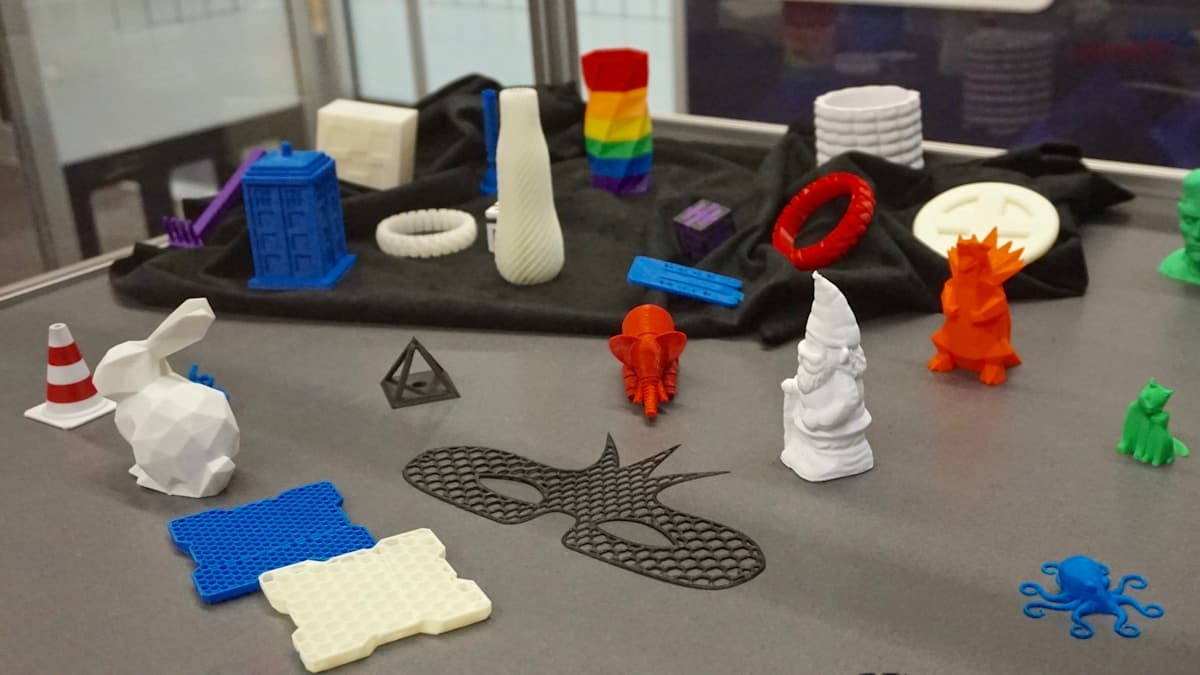
The gap between a CAD file and a functional physical part is where most product development slows down. A 3D printer prototype service closes that gap — typically in 2–5 days — without requiring in-house equipment, material expertise, or operator time. This guide covers how prototype services work, what to expect from the quote-to-delivery cycle, how to prepare files that reduce errors, and how to find providers in the US.
How a 3D Printer Prototype Service Works
The process is straightforward at a reputable shop:
- File submission — You upload an STL or STEP file. Some shops also accept OBJ and 3MF.
- DFM review — The shop reviews the file for printability: wall thickness, unsupported overhangs, feature resolution, mesh integrity.
- Quote — You receive a quote covering material, lead time, post-processing options, and quantity pricing.
- Approval — You approve the quote and pay a deposit or the full amount upfront.
- Production — The shop prints, post-processes, and quality checks the part.
- Delivery or pickup — Parts ship or are available for local pickup per the agreed timeline.
The full cycle runs 2–7 business days for most FDM and SLA work. SLS takes slightly longer. Rush options compress standard timelines at a premium.
What Prototype Services Include That DIY Doesn't
The difference between submitting a file to a service bureau and printing in-house yourself:
DFM feedback. A professional shop catches printability issues before the run. A failed print at a service bureau costs the shop money, not you — they reprint. A failed print on your own machine costs you material, time, and potentially a missed deadline.
Calibrated machines. Commercial shops run calibrated equipment with documented settings. Consumer desktop printers require ongoing tuning. Dimensional accuracy from a professional FDM shop is tighter and more consistent than most in-house desktop setups.
Material depth. Industrial-grade FDM shops stock engineering materials — PETG, ASA, ULTEM, nylon — that aren't available on desktop consumer machines. A prototype service can produce a part in the material the final product requires, not just whatever is loaded.
Post-processing. Sanding, primer, painting, insert installation, threading — commercial shops handle the finishing operations that turn a raw print into a usable part. Doing this in-house requires tools and time most engineering teams don't have.
Accountability. If a part arrives wrong, the shop fixes it at their cost. That accountability structure doesn't exist when you print yourself.
Matching Technology to Prototype Stage
Not every prototype stage needs the same process:
Early concept validation (form check): FDM with PLA or PETG. Fast, inexpensive, sufficient for checking form factors and identifying obvious design issues. Most local shops offer this process. Find FDM providers near you →
Functional testing: FDM with PETG, ABS, or nylon, or SLA with engineering resin. Material matters at this stage — the prototype needs to behave like the final part under real operating conditions.
Production-representative prototype: SLS nylon or MJF. Isotropic mechanical properties, production-level surface finish, no support structure artifacts. Right for regulatory submissions, manufacturing validation, and investor demonstration.
Metal prototype: DMLS/SLM. Required when the part must be metal without tooling. Common in aerospace, medical, and industrial contexts.
Preparing Files for a Prototype Service
Files that go to a commercial shop need to be print-ready. Common issues that cause delays:
- Non-manifold geometry — open edges or intersecting faces that confuse the slicer
- Wall thickness below minimum — features that cannot be printed in the chosen process
- Incorrect units — STL exported in inches when the shop expects millimeters creates a 25.4x scaling error that adds a revision cycle
- Unspecified critical tolerances — press fits and snap fits that work in CAD but don't account for process shrinkage
Run your STL through a mesh repair tool — Meshmixer, Netfabb, or PrusaSlicer's built-in repair — before submitting. Flag any critical tolerances explicitly in your quote request rather than assuming the shop will find them in the file.
What to Include in a Quote Request
When contacting a 3D printer prototype service, include:
- STL or STEP file
- Desired material (or "open to recommendation")
- Quantity
- Target delivery date
- Post-processing requirements
- Any critical dimensions or tolerances
This eliminates the back-and-forth that adds days to the quote cycle. Most commercial shops can turn a complete brief into a quote within 4–8 hours.
Finding a 3D Printer Prototype Service
The 3D Prototyping Hub directory lists over 2,000 verified commercial 3D printing service providers across the US. Filter by your state and city to find local options with available technologies and direct quote request forms.
For teams that run frequent prototype iterations, keeping an in-house FDM machine for early-stage geometry checks reduces service bureau spend and speeds iteration cycles.
The practical workflow for most engineering teams: in-house FDM for concept geometry validation, external service bureau for material-correct functional prototypes and production-representative parts.
Related Reading
- 3D Printing Prototyping Services — Find Local Providers
- 3D Fabrication Services — What They Are and How to Find Them
Browse 3D printer prototype services by state →
Photo credit: Locanam 3D Printing via Unsplash